Want to join the Club?

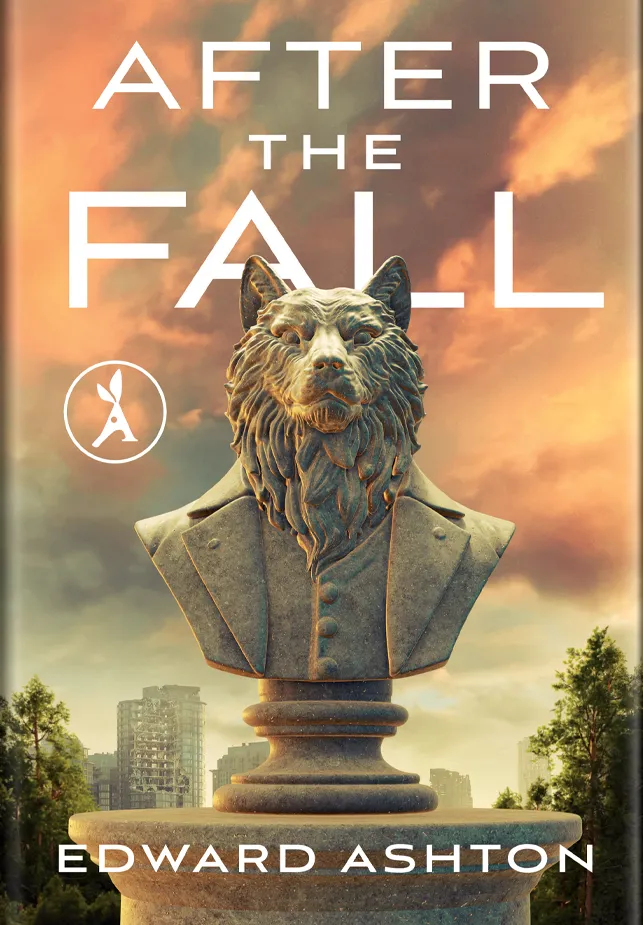
After the Fall

Edward Ashton

Sci-Fi
Satire

At a glance

🤣
Laugh out loud funny
Post-apocalyptic setting
Under 300 pages
🌲
Wellness retreat in the woods

Part alien invasion story, part buddy comedy, and part workplace satire, After The Fall by Edward Ashton, author of Mickey7 (inspiration for the film Mickey 17), asks an important question: would humans really make great pets?

Humans must be silent. Humans must be obedient. Humans must be good.

All his life, John has tried to live by those rules. Most days, it’s not too difficult. A hundred and twenty years after The Fall, and a hundred years after the grays swept in to pick the last dregs of humanity out of the wreckage of a ruined world, John has found himself bonded to Martok Barden nee Black Hand, one of the "good" grays. Sure, Martok is broke, homeless, and borderline manic, but he’s always treated John like an actual person, and sometimes like a friend. It’s a better deal than most humans get.

But when Martok puts John’s bond up as collateral against an abandoned house in the woods that he hopes to turn into a wilderness retreat for wealthy grays, John learns that there are limits to Martok’s friendship. Soon he finds himself caught between an underworld boss who thinks Martok is something that he very much is not, a girl who was raised by feral humans and has nothing but contempt for pets like John, and Martok himself, whose delusions of grandeur seem to be finally catching up with him.

Also, not for nothing, something in the woods has been killing people.

John has sixty days before Martok’s loan comes due to unravel the mystery of how humans wound up holding the wrong end of the domestication stick and find a way to turn Martok’s half-baked plans into profit enough to buy back his life, all while avoiding getting butchered by feral humans or having his head crushed by an angry gray. Easy peasy, right?

Don’t just take
our word for it

"Ashton’s world-building is flawless, and his characters are delightful… With its unique take on the post-apocalyptic, alien-invasion themes and the unusual, sometimes buddy-comedy style relationship between its lead characters, the book will have Ashton’s regular readers cheering, and it’ll send newcomers looking for more books by this one-of-a-kind storyteller."

- Booklist

"If John Steinbeck had written a novel of a post-alien invasion, it might very well look like Edward Ashton’s After The Fall. It is a story of struggling to survive by wit, luck, and dogged determination. It is also equally as harrowing as it is hilarious—a balancing act that few dare try and even fewer can pull off. I didn’t want the book to end. I would’ve happily followed John and Martok anywhere. I miss them already."

- James Rollins, #1 New York Times bestselling author of the Moonfall Saga

"The best buddy road trip dramedy about a guy and his bumbling alien overlord you’ll read all year. Bad decisions and deep existential questions co-exist on this thoroughly enjoyable quest to build a true found family–and maybe even a new sort of civilization."

- Tina Connolly, Hugo-nominated author of Ironskin
Get a taste

“John!” Martok bellows as he bursts through the door. “I have news, my friend— wondrous, wondrous news! You’ll not believe what fell to me in the markets today!”

John turns away from the window, the only one in the bare boardinghouse room he and Martok have shared for the past two months, where he’d been passing the afternoon watching the machinations of a murder of crows as they attempted to scavenge the carcass of a dead rat from beneath the wheels of the passing trundlecars in the street below, to see his patron hanging his formal sash on the hook by the door. Martok’s three-fingered hands are trembling with excitement, so much that it takes him two tries to get the sash to stay, and the crest that runs down the center of his broad bald scalp is flushed a happy pink.

“John!” Martok says again, then crouches so that his head is nearly level with John’s and spreads his arms wide. “Come to me, my friend! This has been a truly wondrous day!”

John hesitates a bare moment, then sighs, crosses the tiny room in three strides, and steps into the gray’s crushing embrace. Martok lifts him, thick hands pressing John against the hairless, wrinkled skin of his chest, spins him half-around, and sets him down again with his back to the door.

“Ask, John! You must ask!”

John takes a deep breath in and lets it out slowly, mostly to make sure Martok hasn’t cracked his ribs in his exuberance, then says, “Please tell me, Martok. What wondrous thing did you find in the markets today?”

He’s expecting to hear something about a new sash, or a refurbished handheld, or perhaps a particularly ripe piece of fruit. Consequently, he has no idea how to react when Martok says, “A home, John! I have found us a home!”

Want to join the Club?

Book notes

  • 🙋‍♀️ Why we chose

    Here’s a question for you, reader: do you see yourself as more of a black cat or a golden retriever? If your answer was anything other than an incredulous “I’m a human,” then have we got the book for you!

    After the Fall is a sci-fi dystopia that asks the pressing question, what if humans were pets? The novel is set in a post-apocalyptic world in which human civilization has fallen and an alien race called “the grays” have ascended to power, benevolently adopting humans as their loyal companions. With a catch: since the story is told through the brainwashed POV of our protagonist John, it can be difficult to tell whether “the Fall” truly occurred as told, or whether the grays deliberately colonized Earth and enslaved humans as their unwilling “bondsmen.”

    What ensues is a charming buddy comedy following John and his gray, Martok, whose loveable whimsy and generous spirit is tainted only by his wildly unpredictable nature. It’s also a poignant exploration of animal rights and the complex dynamics of inter-species power, with several references to the difference between wolves and dogs: despite sharing a common ancestor, dogs have been bred across millennia to be “docile and dependent.” Could the same be said of the humans in this post-Fall dystopia? If John wants any hope of escaping his life of dreary servitude, he needs to access his latent wildness, to shed his dog-ness and channel his inner wolf.