Want to join the Club?

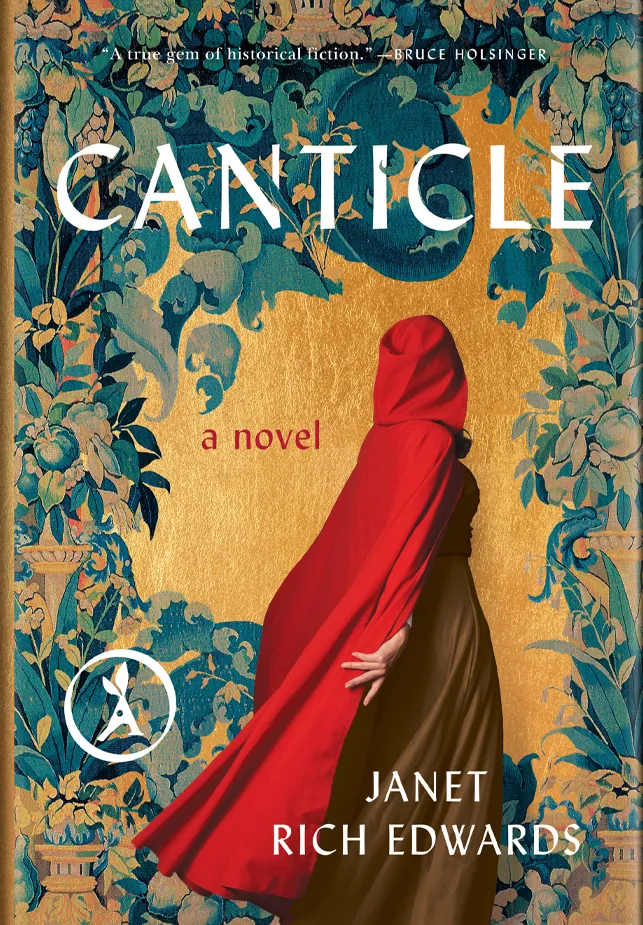
Canticle

Janet Rich Edwards

Debut Novel
Historical
Includes a Cat
Coming of Age

At a glance

🗣
Polyvocal narrative
🦢
Set in Bruges
📜
Illuminated manuscripts
💍
Runaway bride

Set in thirteenth-century Bruges, this debut novel follows a young woman’s explorations of faith, agency, and love among a community of fiercely independent women.

Aleys is sixteen years old and serious, stubborn, prone to religious visions. She and her only friend, a young scholar, have been learning Latin together in secret—but just as she thinks their connection might become something more, he abandons her for the monastery. When her family falls on hard financial times, her father promises her in marriage to the unctuous head of the weavers’ guild, and in desperation she runs away from home, eventually finding shelter within a community of religious women who do not answer to the church.

Among the hardworking and strong-willed Beguines, Aleys glimpses for the first time the joys of a life of song, friendship, and time spent in the markets and along the canals of Bruges. But forces both mystical and political are afoot. Illegal translations of scripture, the women’s independence, and a sudden rash of miracles all draw the attention of an ambitious bishop—and bring Aleys and those around her into ever-increasing danger, a danger that will push Aleys to a new understanding of love and sacrifice.

Introducing a spirited, indelible heroine and a major new talent, Canticle is a luminous work of historical fiction, vividly evoking a world on the verge of transformation.

Don’t just take
our word for it

"Janet Rich Edwards has written a brave, intense novel about the mystical nature of a young woman’s faith and how easily it can find itself in opposition to politics and entrenched power."

- Sarah Dunant, New York Times bestselling author of The Birth of Venus

"In Canticle, Janet Rich Edwards brings the medieval world brilliantly to life, exploring the dreams and desires of a community of women whose fascinating stories sing from every page. The novel is a suspenseful page-turner that is also rigorously researched and utterly convincing—a true gem of historical fiction."

- Bruce Holsinger, author of Culpability

"Compelling, lyrical, and fresh, Canticle is a conjuring—of time, place, society, struggle. A tale of immense beauty, kinship, and how vision can be gift and curse in a world where the belief of a few can stifle the truth of the many, Aleys’s story is a miraculous work of historical fiction."

- Kiran Millwood Hargrave, author of The Mercies

Get a taste

Brugge, County of Flanders, 1299

The young woman appears in the square, wearing neither veil nor wimple, her short brown hair plaited behind her neck. She’s covered by a cloak of fine maroon wool; specks of white ash have drifted to land on her shoulders like snowflakes. The acrid smell of bonfire is already in the air. Witnesses will later swear the girl was lit like a taper, and some will claim she had a halo. They’ll say the brass steeple cocks spun as she entered the square and the clouds broke apart, fleeing south, fleeing north, at once all directions, impossible. Church bells snapped their stays and a wild clanging rose from every corner of the great city. No one is quite sure what happened.

As the crowd parts before her, Aleys sees the path of gray cobblestones receding to the stake. Parchment is piled high at its base. Smaller fires have already been lit, dotting the plaza. They’re burning her words, too.

A chant of “Sint! Sint!” rises from the crowd. Even now, even though the Church has named her heretic, the people still call her saint. It’s true and not true. They are all saints. They are none of them saints. They think her a miracle worker. They think she speaks with God. But really, everyone does. It’s just so hard to hear.

She takes a step, another step, her heart hammering.

Adieu, she thinks, I go to God. This time, truly, I go to God.

Want to join the Club?

Book notes

  • 🙋‍♀️ Why we chose

    We at Aardvark can’t resist a nuanced depiction of Medieval women’s lives, and Canticle certainly provides. Gorgeously written and transcendent, it tells the tale of a religious girl’s coming-of-age in thirteenth century Bruges, while the church is on the brink of tremendous transformation.

    Escaping an unwanted marriage, Aleys flees to a beguinage (which is like a convent, but for non-cloistered laywomen). The beguinage, largely dismissed in religious history, was actually a crucible for radical thought, home to a sort of proto-feminist movement. What follows is a reclamation of holy women’s power, writing back to the systems of oppression and exclusion that keep God’s word contained to the hands and minds of the elite.

    The beguines rail against the wrongs that plague the church—for example, the use of Latin for recording religious texts, gatekeeping those without access to the esoteric language (women) from reading and interpreting them. In this way, Aleys is an accidental revolutionary: she learns Latin independently, using this skill to translate scripture into vernacular Dutch and enabling fellow women to read and interpret scripture for themselves (heresy!). She empowers Marte, a maid at the beguinage, to retell Bible stories from her long-ignored women’s perspective—in one telling, Lot, rather than his wife, is the one turned into a pillar of salt. Through the rebellion of these holy women, Canticle offers up a much-needed alternative to the church’s singular, and often misogynistic, interpretation of holy texts.

  • ⚠️ Content warnings

    Attempted sexual assault.