Want to join the Club?

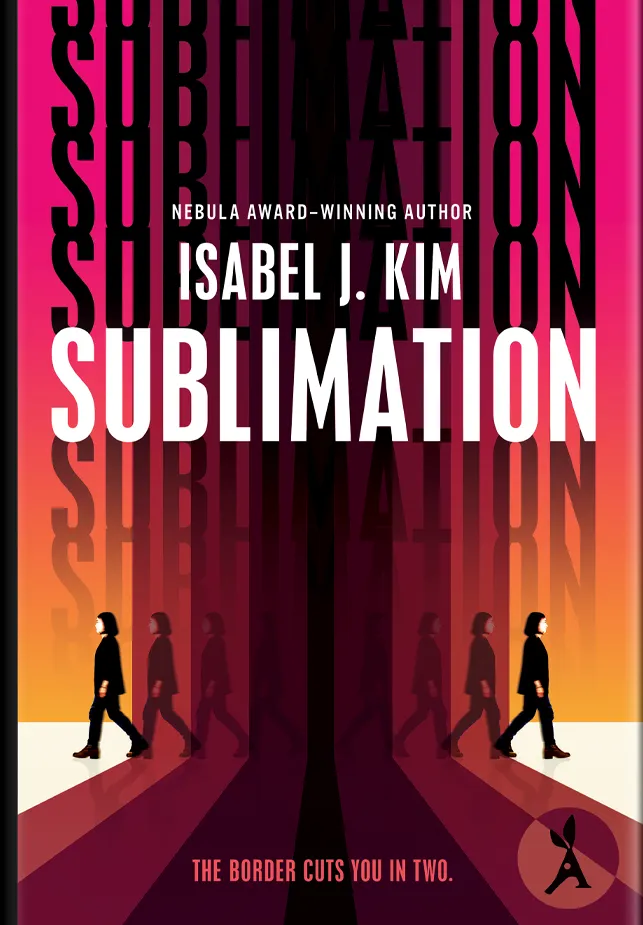
Sublimation

Isabel J. Kim

Debut Novel
Sci-Fi
Thriller
Movie/TV Coming
Includes a Cat

At a glance

🧳
Explores immigration
🗣
Polyvocal narrative
🏙
NYC & Seoul
🎥
For Past Lives fans

Doppelgängers, corporate intrigue, heartbreak, betrayal, and the harsh permanence of the border: Sublimation is a thrilling and provocative debut for fans of Severance that asks what you'd sacrifice for a different life from award-winning author Isabel J. Kim.

The border cuts you in two.

When you immigrate, you leave a copy of yourself behind, an instance. One person enters their new country; the other stays trapped at home.

Some instances keep in touch, call each other daily, keep their lives and minds in sync in the hopes of reintegrating and resuming a life as one person. Others, like Soyoung Rose Kang, leave home at ten years old and never speak to their other selves again. Rose, in America, never imagined going back to Korea until her grandfather died and her Korean instance called her home for the funeral.

She doesn’t know that Soyoung plans to steal her body and her life.

How far would you go to live the choice you didn’t make?

Don’t just take
our word for it

"In this dazzling parable of connection and isolation, Isabel J. Kim’s vividly crafted characters navigate identity, belonging, and the weight of a divided history."

- Scott Westerfeld, author of Uglies and The Mortons

"Beyond candescent… after Sublimation, the immigrant story will never be the same. Kim is a nerve-wracker and a heart-render, a Seoul-lighter and a world-raveler; she also happens to be one of the finest writers working today."

- Junot Díaz, Pulitzer Prize-winning author of The Brief Wondrous Life of Oscar Wao

"One of the best debuts of the year. Sublimation speaks to our moment, in ways we could not have expected."

- John Scalzi, New York Times bestselling author of Starter Villain
Get a taste

“Do you think it’s emotionally equivalent to murder?”

Yujin chokes on his latte. You take a smooth sip of your Americano. In retrospect, that was a morbid thing to say. It doesn’t fit the setting. You’re sitting in the basement of the Shinsegae Department Store, waiting for your instance in the cafe near the rotating displays that guard the entrance. The salespeople are loudly promoting dried persimmons in fancy gift boxes (Half off! Today only!). Commuters in nice clothing hurry past, using the food hall as a shortcut to the subway. Tourists examine the stalls and malinger.

The Shinsegae Department Store basement used to be your favorite place in all of Seoul. Your mom always took you through when you visited her at work, and you’d pick out something delicious (twigim, mandu, jun) to augment dinner at home. But these days, the physical reality of the basement always disappoints you. Everything is smaller, shabbier, too loud and not as wondrous. The jun don’t taste the same. They got rid of the ice cream stall you liked. You wonder if your instance will feel the same way, or if the years between visits will preserve some sort of magic when she returns. You kind of hope it will feel perfect for her, because you’d like to experience that perfection again. If and when she agrees to reintegrate. Or else for you, the memory will stay bittersweet and choked forever, because Harabeoji is dead and you’re never going to eat dinner with him again.

You feel regular about that. By regular, you mean very bad. Bad enough that you’re blithely asking Yujin about whether reintegration would be murder. That’s an awful thing to say to Yujin specifically, because Yujin talks about his other self like his instance will save him. But you can’t help yourself.

You want to stop talking about death but it keeps seeping out through the seams. You’re angry about that. Things shouldn’t matter to you so much; Harabeoji’s death shouldn’t be affecting you so greatly. It was a foregone conclusion, and it’s not like your mom or your fiancé or any of your friends or anyone young has died. This wasn’t a surprise death. So you’re in your twenties and your grandfather dies. So you knew it was coming. So you still feel like shit about the whole thing, and worse than shit, you feel guilty, because there’s the relief mingled in with the sadness— the relief of foregone conclusions. He’s dead and gone and you aren’t waiting for the drop anymore. What a terrible grandchild you are! Except, no. You’re allowed to feel however you want. Maybe you shouldn’t even feel bad. You visited him every other week in the house you grew up in, choked with slowly advancing vines. And you’re pretty sure he loved you the best, even if he called Minsoo his favorite, because Minsoo was the firstborn son. That love: another foregone conclusion.

“Murder?” Yujin says, and then in English, “Murder? Like, killing people?”

“Yeah, murder. Emotional murder.”

Want to join the Club?

Book notes

  • 🙋‍♀️ Why we chose

    We love a high-concept spec-fic, and Sublimation’s is pretty much in the clouds.

    Here’s the premise: when someone immigrates, they leave a copy of themself behind (an “instance”), splitting their consciousness into two (“instancing”). Sublimation literalizes the diasporic experience, imagining the “before” and “after” of immigration as two separate identities. And are they even the same person anymore?

    The novel’s concept is both hyper-contemporary (a clever metaphor for the American immigrant experience) as well as deeply historical, even mythological. The author offers examples of archetypal instancing narratives: The Odyssey, for example, or the Book of Genesis. These stories are born from hinge moments—Odysseus embarking on his decade-long voyage, Eve biting into the forbidden fruit. The choice could go either way, and yet, “the version of Odysseus that stays home, how does he live? There are no grand epics about him.”

    Even then, Sublimation piles on layers of indecision, with the introduction of “reintegration” and “Mitosis,” procedures that allow instances to swing back and forth. These represent the perpetual angst of living as an instance (or immigrant), the deep desire to be in two places at once: home and away.