Want to join the Club?

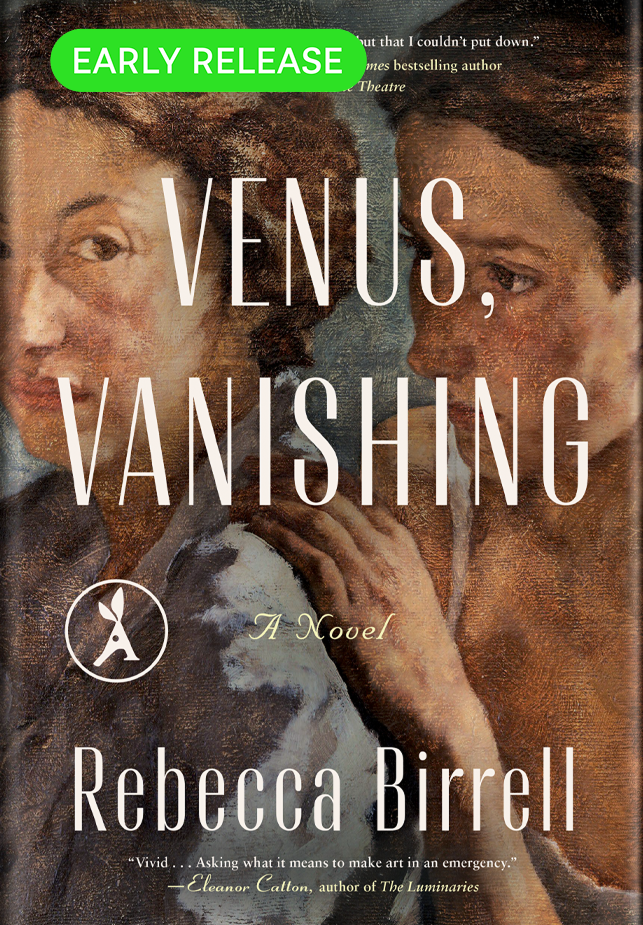
Venus, Vanishing

Rebecca Birrell

Debut Novel
Historical
LGBTQIA+

At a glance

🖼
Art history buffs
🌈
Bisexual representation
📍
Set in Berlin
🎨
List of paintings included

Portrait of a Lady on Fire meets The Safekeep in this gripping debut that reckons with art forgery, desire, suspicion, and resistance.

In raucous 1928 Berlin, Hannah Sherman has deviated from the traditional arc of a woman’s life. An artist and a runaway, she revels in the city’s underground art scene and her newfound freedom. Working as a tailor while studying art in every spare moment, Hannah comes to know women and their bodies, first with measuring tape and silk, and later through sensuous layers of paint.

Hannah feels like she can finally call herself an artist when an intoxicating, wealthy female collector commissions an elaborate series of nude portraits. But after Hannah finishes the acclaimed Venus paintings, she discovers that her work has been tampered with and exhibited under a man’s name. When lines between artist and muse are crossed in a heady but perilous affair, Hannah transforms her work into an act of revenge, finding herself caught up in a devastating game of betrayal.

‍

Laced with queer desire and life-threatening secrets, Venus, Vanishing pulses with the hedonism and danger of 1930s Berlin as history comes to Hannah’s door, offering a heart-pounding story of Jewish survival, creativity, and resistance.

Don’t just take
our word for it

“Venus, Vanishing is so rich in nuance and complexity that I want to take a bite out of it…This novel is full of characters who talk and act like people, who make decisions real people would make. This relatability made the plot feel relevant in a way that was both unsettling and, somehow, comforting. The world has always been scary, and people have always been imperfect, but also there’s always been love and friendship and art and messy queer polycules. I’m going to be thinking about this book for a long time. ”

- Literary Hub

“Venus, Vanishing is so rich in nuance and complexity that I want to take a bite out “It’s Berlin in 1928, and Jewish artist Hannah is enjoying her newfound freedom. After Elke, a wealthy female collector, commissions an elaborate series of nude portraits, the ‘Venus’ paintings, Hannah discovers that her work has been exhibited under a man’s name and seeks revenge even as her world begins to change. Rebecca Birrell, a curator and art historian, draws on her background in the art world in her captivating debut novel. As she explains of her motivation for writing this story: During the Holocaust, ‘Art was a survival strategy. It was a means of escape and sustenance; it was an act of defiance, an affirmation of self.’”

- Town & Country

“If you loved I AM YOU by Victoria Redel (a Gays Reading book club pick last year), you'll feel right at home here. But VENUS, VANISHING hits differently right now, in a moment when both queer and Jewish visibility is under renewed threat and "just be a little less yourself" is advice many of us are hearing again, dressed up in nicer language.”

- Jason Blitman, Gays Reading Podcast

Get a taste

She only ever came to the shop with a navy wool skirt suit, tailored at an atelier in Paris. The waist needed taking in half an inch. A button re-threading. A clean and press. She couldn’t trust anyone else with it, she said. Often, the repair was so small I suspected she just wanted to be touched, admired. I never asked where she took her other clothes. Perhaps each garment required its own seamstress: There were stranger ways a woman might fill her time. I was happy to indulge the customer’s eccentricities, curious about her in the way I was about most women with money. But Mother wasn’t. The customer was nosy and overfamiliar, frankly a little odd, Mother said, smoothing a pile of folded sheets with a vigor that implied they might fight back. Mother soon found ways to occupy herself when this woman arrived, distractedly waving her in before disappearing without explanation into another room.

‍

Out of Mother’s coldness, I became this woman’s seamstress. Her clothes had an aura of quality that was impossible to ignore, like a cloud of white steam in a cold room. She was no less extraordinary. Tallness and thinness accentuated by a large  oval face and hair so fair it appeared colorless. She came from a part of Berlin that wasn’t far on the tram but as distant to me as another country. I had a precise image of her house: four stories filled with tasteful antiques, a foyer large enough for twenty guests, the upper floors still and quiet as dawn at all hours. In a low voice, she recounted trips to cities reached on sleeper trains, what might be bought at this bazaar or eaten at that tavern on the hill where locals congregated like a murmuration of birds and music could be heard late into the night. I began to look forward to her visits. When I had her in the room, I retrieved pins from my workbasket one by one, slowed my sewing hand, made subtle mistakes I would have to correct, all to lengthen her stay. When she left, insisting she wouldn’t be back for months— she would normally telephone the shop a few days later— parts of her remained in the room. A jasmine cologne so strong that I always knew the banknotes that came from her purse. Blackened matches on the floor. A clean monogrammed handkerchief, ironed flat: E.G. Mother called her Frau Grese, but when I began to take care of the suit myself, the customer insisted I call her Elke.

Want to join the Club?

Book notes

  • 🙋‍♀️ Why we chose

    Venus Vanishing has prose so seductive, reading it makes you feel like you’re a Venus yourself: reclining on your velvet divan, a sheer wisp of fabric clutching at your hips, red grapes spilling into your mouth like delicate words across the page. Prose so chic you’ll feel so like you’re entangled in a multi-partnered love affair, where you can have both the handsome gallerist and the sultry cabaret dancer, your life plunging forward in step with the German avante-garde. Prose so skillful you’ll feel like a wildly successful painter, your calloused seamstress hands capable of creating something sublime, with the capacity to move an entire populace. 

    Except that moving an entire populace might not be a good thing after all…especially when your work is being displayed not as art, but as propaganda. Because the year is 1933 and a man with an unspeakable name has just been elected into power, and your patron (who also happens to be your favourite lover), might just be a sympathizer.

  • ⚠️ Content warnings

    Antisemitism, WWII setting.

  • 🙂‍↕️ The Nod by Gays Reading

    VENUS, VANISHING is Rebecca Birrell's debut novel, is ultimately a story about what it costs to hide who you are. Hannah Sherman is a Jewish artist coming of age in Weimar Berlin, attempting to establish a life as a painter, building something real for herself. When a wealthy patron offers her more (money, opportunity, a shot at the art world), Hannah is asked to sacrifice everything she has to get everything she's always wanted.

    It's historical fiction, but don't let the gallery scenes fool you. This book is about the bargains marginalized people have always been asked to make. (In this case: queer and Jewish) Birrell, an art historian by training, writes with a painter's eye for detail and a clear-eyed understanding of how erasure works.

    If you loved I AM YOU by Victoria Redel (a Gays Reading book club pick last year), you'll feel right at home here. But VENUS, VANISHING hits differently right now, in a moment when both queer and Jewish visibility is under renewed threat and "just be a little less yourself" is advice many of us are hearing again, dressed up in nicer language.

    Devastating, beautiful, and far more relevant to 2026 than any book set in 1928 has a right to be, VENUS, VANISHING earns The Nod™ by Gays Reading.